haf vol 17: TRAIN SMARTER. GET STRONGER.
What’s up Garage athletes,
Over the next eight weeks, we're going to ask your body to do something remarkable: adapt.
One of the greatest lessons I've learned as a nurse practitioner with 20 years of coaching is that the human body doesn't distinguish between training stress and life stress. A heavy squat session. Poor sleep. A demanding week at work. A difficult conversation. They're all physiological inputs your body has to process. Your body doesn't separate those stressors. It adds them together. Exercise is simply another stressor.
Every day, your body is making one decision:
Do I have enough resources to adapt?
When you expose your body to the right amount of stress, something remarkable happens. Muscle fibers remodel through muscle protein synthesis. Your nervous system becomes more efficient at recruiting motor units and producing force. Tendons and connective tissue increase their capacity to tolerate load. Bone responds to mechanical loading by becoming stronger.
This is adaptation. But adaptation is earned, not guaranteed.
Too little stress, and the body has no reason to change.
Too much stress without adequate recovery, and performance begins to decline.
The goal of great programming is to create the right physiological stimulus while teaching athletes the self-awareness to respond to it.
At The Garage, that's exactly what we do. Every class on our schedule has a specific physiological objective. And this current HAF cycle continues that philosophy with several intentional changes, like beginning class with a programming brief before movement prep. And- calculating warm-up sets that better match our training top-set goals and physiological readiness. We will walk you through exactly how it works. This new cycle challenges the idea that self-awareness is the foundation of performance. The athletes who improve the most aren't always the ones who train the hardest. They're the ones who understand how their bodies respond to stress, recovery, and adaptation.
If you're new to HAF, don't be surprised if you take longer rest periods than you're used to. Maximal strength depends on producing high-quality force, not accumulating fatigue. Recovery between sets allows your nervous system to continue producing force at a high level.
Over the next eight weeks, you'll have plenty of opportunities to put your training to work. Whether that's Filthy Four, Triathlon, Face-Off, Hyrox, Chi Marathon, adding more weight to the bar, or simply moving with better quality than you did last cycle– every challenge is an opportunity to see what your body has become capable of.
Now, let’s talk training.
.
NEW BLOCK, NEW ENERGY. Volume 17 is here, and we’re really excited about this one. Here’s everything you need to know going into this cycle:
Summer is in full swing, and we’re just coming off our Peak Week, where we tested a heavy 1 or 3 rep of our main lifts. For everyone new here, Heavy AF (HAF) follows a principle in resistance training called Progressive Overload. This principle relies on consistently progressing your lifts week by week to increase neuromuscular demand, facilitate gains, build strength, and ensure each session challenges you to work a little harder than the last.
HAF V17: Strength in the Position
Think about the last two volumes as a progression. V15: you found your positioning with pin squats, Larsen presses, and paused reps. V16: you owned your positions. Tempo work and time under tension forced you to stay connected throughout every phase of the lift. That humbled a lot of us and you crushed it anyway. In V17, you EXPRESS that strength. NOW WE LOAD THE PATTERNS! You’ve earned the weight. You’re not going heavier because the program says so. You’re going heavier because you’ve proven that you can own the positions to move it. Big. Big. Difference.
Heads up– Here’s what’s happening in this block:
Coming up: Over the next eight weeks, you'll have plenty of opportunities to put your training to work. Whether that's the Filthy-Four, Chicago Triathlon, Deka Fit, Hyrox, or our one-and-only FACE OFF GAMES (approximately 2 weeks after this block wraps up). If you’re competing at Face-Off, week 8 will function as your taper. The first two weeks of the following cycle will also be dialed back in intensity so that when you arrive at competition, you’re fresh and ready to send it! For those of you preparing for the triathlon & marathon, this cycle was built with you in mind. Nordics, landmine curtsy lunges, and single-leg hip thrusts are in the programming specifically to develop the hamstring strength and unilateral hip power your run stride demands as mileage starts to increase. You’re in the right place.
A FEW THINGS ARE CHANGING IN CLASS:
We’re tightening up the class structure so athletes can head straight from the warm-up & movement prep into their lifts. That means arrive on time, or you’ll miss important coaching cues and movement demos. Here’s the new flow: we'll open with a daily program overview and movement demos, then move straight into the warm-up. No more downtime between the warm-up and the main blocks.
We are also introducing a pre-calculated way to load your bar. Instead of guessing what to throw on the bar and grinding through the same reps until you find the right RPE, we'll be using a calculated build-up system tied to your top set goal of the day. Yes, it involves math. But it works. Think of your build-up sets as practice reps that prime your body and nervous system for the work that matters most. By following the written progression, you'll arrive at your top set with the target RPE & weight of the day, feeling confident and right where you need to be. This is the perfect time to use those tracking sheets: especially if you haven't been. Have a goal! That is how you get stronger.
Here's the Build-Up System:
(1) Record your top set goal & calculate your build up sets
(2) Bar only x 8-10 reps
(3) ~50% x 5 reps
(4) ~70% x 3 reps
(5) ~85% x 2 reps
(6) ~92% x 1 rep
Make sure you calculate your progression first. We’ll begin using no weight. This is non-negotiable. Get the movement down. If you can’t control the bar, you can’t control the load. At ~50% start to feel the reps out, at ~70% start feeling the load, at ~85% it should feel more serious, then ~92% will prime your nervous system to say yes we can do our top set today. If that 92% moved well…then you’re good. Load up to your top set and go get it! If it DID NOT move well, then drop the ego. Drop your top set by 8-10lbs and hit that instead.
Now here’s the part that ties it all together: RPE. Rate of Perceived Exertion (RPE) is basically a measure of how hard a set actually felt.
RPE 7: You finished the set, but you had about 3 reps left in your tank. It was working, but not grinding.
RPE 8: Challenging, but in control. About 2 reps left in your tank.
RPE 9: HARD. You could have done 1 more, but it would have been a fight.
RPE 10: Everything you had. Nothing left in the tank.
The RPE target is your guide for how heavy your top set should actually feel that day. So when you’re building up through your 50% → 70% → 85% → 92%, you’re not just chasing a random number on the bar– You’re checking in with your body at each step. If your 85% already feels like an RPE 9, then that’s your information. Adjust before you get to your top set, NOT AFTER.
The goal is simple, stop guessing and start calculating your build up sets.
Accessory work: make sure you do them! These are NOT just fillers. As a matter of fact, these are one of your most important lifts of the day. The main lifts are what will get you strong, but the accessory lifts are what will keep you in the game long term.
Now here’s what you’ll be doing each day:
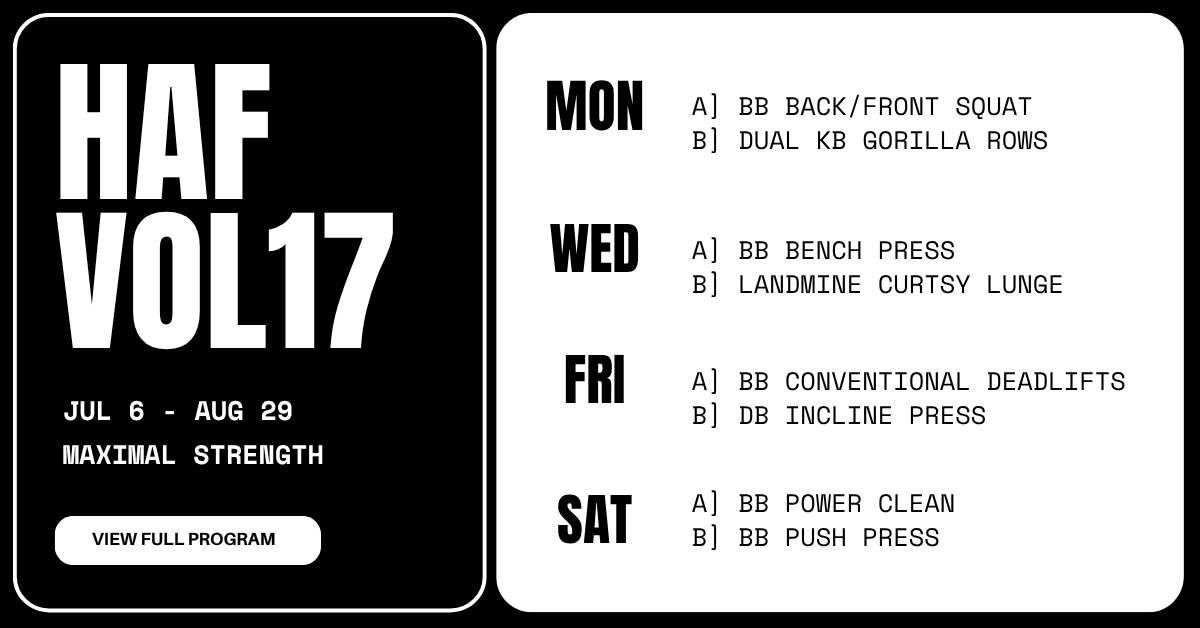
MONDAY
A] BACK or FRONT SQUAT
B] DUAL KB GORILLA ROW
Keeping it squatty on Mondays. Athletes choose either a front or back squat variation. Weeks 1-4: Athletes build to a top set of 1x5, with RPE progressing throughout the cycle. Back-off sets follow at higher rep ranges to reinforce movement quality and build the muscular endurance that supports marathon, triathlon, and Athalon training (and daily life!) You are building confidence, even under fatigue.
Weeks 5-8: Athletes will progress to a heavy 1x3 top set as they enter peak week. All squats will be performed in a full range of motion. You know what the bottom position feels like from the tempo and pauses from past cycles. Now we load it with confidence and control. Our B Block movements continue to support a quality squat and posterior chain strength. Dual KB Gorilla Rows reinforce the upper-back strength required to perform heavier barbell squats without adding significant spinal loading on an already demanding squat day. Key reminder: maintain your brace throughout your sets! This is just as important as the row itself.
We’re also introducing something new: the Single Leg Landmine Hip Thrust. This is a fun one! This is a direct carryover to running push-off mechanics, essential for our marathon or triathlon athletes, casual runners, or anyone who just wants to become a better, more powerful athlete. This is where you will develop strong unilateral hip power and extension.
Core on Mondays focuses on sagittal work with Deadbugs and anti-rotation variations throughout the cycle. A note on Deadbugs: the goal is not simply to move your arms and legs. The goal is to maintain your trunk position and create tension throughout the entire core. If you're in a Deadbug position and your coach can slide a hand underneath your lower back, you're missing the point. Deadbugs are a bracing exercise, not a coordination exercise.
WEDNESDAY
A] BB BENCH PRESS
B] LANDMINE CURTSY LUNGE
Midweek we’ll see our upper body-focused main lift: Bench Press. For weeks 1-4, build-up sets will be performed as a Block Bench Press. The shortened range of motion allows you to handle heavier loads while maintaining strong positioning. This is about building confidence under the bar, not grinding. Back-off sets return to full range of motion so athletes don't become dependent on the partial range. Do not base your back-off weight on how your top set felt. Trust the prescribed percentages and execute every rep with high quality.
Weeks 5-8: All bench work will transition to full range of motion, building to a heavy 3RM for Peak Week. Wednesday's secondary movements are built to support both a strong press and a strong running stride. Landmine Curtsy Zercher Lunges are a direct carryover for our runners and hybrid athletes, reinforcing control during the landing and braking phase of the stride, where many athletes tend to break down. You'll develop knee control, hip stability, and deceleration strength here.
The Single Arm Standing DB Arnold Press compliments the main lift without competing with it. As loading intensifies toward Peak Week, manage your effort accordingly. This is a support movement, not the star. Core will progress through a plank walkout to a rollout series. If the lower back is arching or the ribs are flaring, you've moved beyond what you can actually control. Own the position first, then increase the range. Stay consistent, and you will see the results, just like any other movement. We'll close out Wednesdays with a tricep burner: high-rep, high-intent, and exactly what your pressing strength needs to keep growing. Arms don't build themselves.
FRIDAY
A] CONVENTIONAL DEADLIFT
B] DB INCLINE PRESS
All athletes will be pulling conventional this cycle. Like our Wednesday bench press, weeks 1–4 will see build-up sets with a shortened range of motion, performed as Block Deadlifts. The barbell will be set on 45 or 55 lb plates, pulled from a slightly elevated position. Like the Block Bench, the purpose is to build confidence under a heavier load while maintaining a neutral spine and strong brace. Back-off sets return to full range of motion from the floor. This should not be a grind. Trust the percentages and execute.
Weeks 5–8: All sets return to full ROM, building to a heavy 3 or 3RM. (Athalon competitors: Peak Week will serve as your deload. You'll arrive at competition two weeks later fresh and ready to send it.) We’ll be continuing to develop upper body strength and strong pulls with a DB Incline Press (supports a strong bench press without the demands of a heavy barbell) and our pull-up progression on Fridays.
Last cycle, we started with seated pull-ups to build the pulling pattern and proper lat engagement with assistance. Now, we are progressing to hang holds for the first 3 weeks to develop grip strength and shoulder endurance under load. Then we move to scapular pull-ups in weeks 4-6 to reinforce scapular control and proper initiation of the pull-up, finally finishing the cycle with full pull–ups -assisted with a band or non-assisted- to express total upper-body pulling strength!
Nordic Hamstring Curls round out Friday accessory work with a focused progression. In the first 3 weeks, you’ll learn the pattern and control the lowering phase using a Nordic Catch. We’ll then progress to band-assisted, then non-assisted Nordics to increase range with control and develop full hamstring strength. Your hamstrings are the drama queens of the posterior chain. They'll get stronger; you just have to earn it.
SATURDAY
A] BB POWER CLEAN + OH PRESS
B] BB SPLIT SQUAT
Our Saturday programming is brought to you by Coach Vinny, and if developing some serious power with our olympic lifts is your thing, we’ve got you. Last cycle, we spent four weeks cleaning up bar path and timing with tempo work, paired with some seriously demanding shoulder stability through Earthquake Presses and Pin Presses. You built a stronger overhead position than you probably realize. Volume 17 puts it to work.
We open our main block work with technique prep: Muscle Cleans and Tall Cleans with the barbell at light load. These are not warm-up filler. Muscle Cleans eliminate the pull-under and force you to drive the bar with your legs and traps. Tall Cleans train you to receive it fast, in a strong rack position. Five minutes of intentional practice here pays dividends in every working set. Paired with build-up sets, you’ll be doing adductor accessory work. Strong adductors are a non-negotiable piece of staying healthy under the demands of cleans, squats, and running volume. Get them done.
For the first four weeks, athletes will perform Hang Power Cleans paired with Push Presses, using moderate loads and higher volume to reinforce consistency, overhead confidence, and strong receiving positions. During the second half of the cycle, working sets progress to a heavy 1+1 Clean + Overhead, where athletes can continue with the Push Press or transition to a Push Jerk as their overhead variation. If you've been developing your timing and dip-drive, this is your opportunity to put it to work. Peak Week offers the option to test a heavy 1+1 or accumulate quality heavy singles with guidance from your coach.
Supporting work this cycle includes your choice of Front Squats or Split Squats, depending on your individual goals, explosive Sled Presses to develop horizontal power, and Hanging Knee Raise to Toes-to-Bar progressions that allow every athlete to continue building core strength and gymnastics capacity at their own level.
We'll finish each Saturday with heavy Farmer Carries paired with high-volume banded hamstring curls to build grip strength, trunk stability, and a resilient posterior chain. If becoming a stronger, faster, more technically efficient athlete is your goal, Saturdays are where you'll want to be.
SPRINT PROGRAM
Chicago running is at an all-time high, and the Chicago Marathon is only 14 weeks away (it'll be here before you can blink). Whether you're training for the Filthy four, triathlon, marathon, or simply want to get faster, now is the time to build speed into your week. We intentionally program a sprint progression for our Wednesday Sprint session. Improve running efficiency, build speed and power, increase endurance, and become a stronger and more confident runner. Like Garage Run Club on Mondays, Wednesday Sprint (5:55 AM at West Town) is complimentary for all athletes; just sign up in our app. No matter your pace or experience level, these sessions are built to help you run better and feel stronger doing it.
SX: Building Athletic Power
STRONGX (SX) is where we take the strength you’re building in Heavy AF and teach you to express it through speed, power, and athletic movement. While HAF develops your foundation, SX is designed to improve how efficiently you produce and absorb force– helping you jump higher, move faster, becoming more explosive, and ultimately perform better both inside and outside the gym.
This cycle, each SX day will has a dedicated power focus that progresses over the full training cycle:
Tuesday:Horizontal Power
Thursday: Vertical Power
Saturday: Rotational + Upper Body Power
Rather than constantly changing movements, you’ll see repeated exposure to key power exercises throughout the cycle, allowing you to build better technique, increase output, and track real progress over time. As always, we’ll finish each session with conditioning, because developing resilient, well-rounded athletes is what we do best.
___
The athletes who make the biggest progress this cycle will be the ones who show up consistently, respect the progressions, have self-awareness, and treat every rep like practice for the next PR.
We’re so proud to coach you.
Excited to see what you accomplish over the next eight weeks!
Save the Date:
Fri Aug 14th 5:30 PM Filthy Four
Sun Sep 13 8:00 AM Face-Off Games
Sun Oct 11 8:00 AM Chi Marathon
Sun Nov 8 8:00 AM 3-2-1 Hybrid Teams
With love,
The Garage Chicago Team