haf vol 16
What’s up Garage athletes,
It's that time again, to apply a different training program, work on new training techniques, and continue to build toward becoming the strongest and best community in Chicago! In this post, we will discuss our training concepts for the next eight weeks. Providing you with a detailed breakdown of our main movements and plenty of inspiration to accelerate your progress.
Get ready for Garage door open season, outdoor sofa hangs, competition season in full send, and the very best community events. We are already enjoying all the sweaty park, block runs, and increasing miles under the sun. TGC thrives in the summer!
Coming up, we have: Murph, Windy City’s Strongest. Hyrox NYC. 13.1. Urban Iron. Peace Runners Juneteenth 5K. Apex. And somewhere in the middle of all of it, we’re opening another Garage community.
Lincoln Park opens June 1st.
We’re not even open (yet), and already 39 LP Day Ones have joined Team Garage. Three weeks out. 11 Founding Memberships left.
Now, let’s talk training.
For those who might not be familiar, our HAF (HEAVY AF) class follows a principle in resistance training called Progressive Overload. This principle relies on consistently progressing a main lift week by week to increase neuromuscular demand, facilitate gains, build strength, and ensure that each session challenges you to work a little bit harder than last time.
Since mid-March, our focus has been all about positioning: Find your positions, build your strength there.
The progressive variable, the last volume, was positional demand and control at depth. Week by week, we increased the amount of tension, stability, and confidence required in deeper ranges of motion under load. From removing the pins to introducing pauses, the goal was never simply to move heavier weight, it was to own stronger positions throughout the lift.
And honestly… that humbled a lot of us.
But you guys really f*cking crushed it.
This next volume shifts the focus toward TEMPO, tension, and force production throughout every phase of the lift. In the first four weeks, our athletes will work through a controlled 3-2-1-0/1 tempo during all build-up sets:
3-second eccentric (lowering) phase of the lift
2-second pause in full range of motion
1 strong concentric drive up
0/1-second reset before the next rep
By intentionally slowing movements, athletes are forced to maintain tension, stability, and control throughout every phase of the lift rather than relying on momentum to move through weaker ranges of motion. The slower lowering phase increases positional awareness and time under tension. The pause challenges athletes to stay connected and produce force in vulnerable positions. Then, from a dead stop, athletes must intentionally drive through the movement rather than bouncing out of it. In short, Tempo work exposes weaknesses. And that’s exactly why it works.
The goal is not simply moving weight from point A to point B. The goal is building stronger movement patterns, more confidence under load, and better force production throughout the entire lift.
Back-off sets will return to regular tempo, allowing athletes to continue to accumulate volume while progressively increasing load as we move toward heavier intensities in Weeks 5–8. Then, Test Out Week will once again give athletes the option between testing a heavy triple or a heavy single.
Now, for those of you who tested out last week, let's talk about what those 1RM/3RM numbers actually mean for your training going forward:
1 REP MAX (1RM):
You have a real number to work with. No more guessing on Rate Perceived Exertion (RPE). If you hit 225lbs on your Front Squat, and tomorrow our Week 1 program calls for RPE 7, that puts your top set somewhere around 225 x 70% = 157#. It is important for you to continue building toward that 157# through warm-up sets, and remember: tempo will quickly humble the load. But now your training has a real reference point.
3 REP MAX (3RM):
A 3RM typically represents around 93-95% of your true 1RM, which means your actual max is higher than you think. So when tomorrow our Week 1 program calls for RPE 7, you likely have more room to work with than you think. If you hit 225lbs on your Front Squat for 3 reps, that puts your top set somewhere around 225 x 70% = something more than 157#. Trust the process and don't undersell yourself on loading.
A couple of things that will make a big difference as we begin a new program:
Keep your jumps small, nearing the top sets. As you work up to your heavier sets, resist the urge to make big jumps. Small, controlled increases keep your technique sharp and your body prepared for the load, following true RPE. This is where those 1.25lb white plates (the cream cheese on top, as Coach Lee fondly calls them) become your best friend, USE THEM. There is no such thing as too small a jump when you're nearing a top set. The athletes who track and respect this process are the ones who make the best progress.
Track your numbers! We highly encourage everyone to log their weights every session. You can't manage what you don't measure, and having your numbers week over week will make RPE and loading decisions so much easier and more accurate.
Now, let's get into the nitty-gritty.
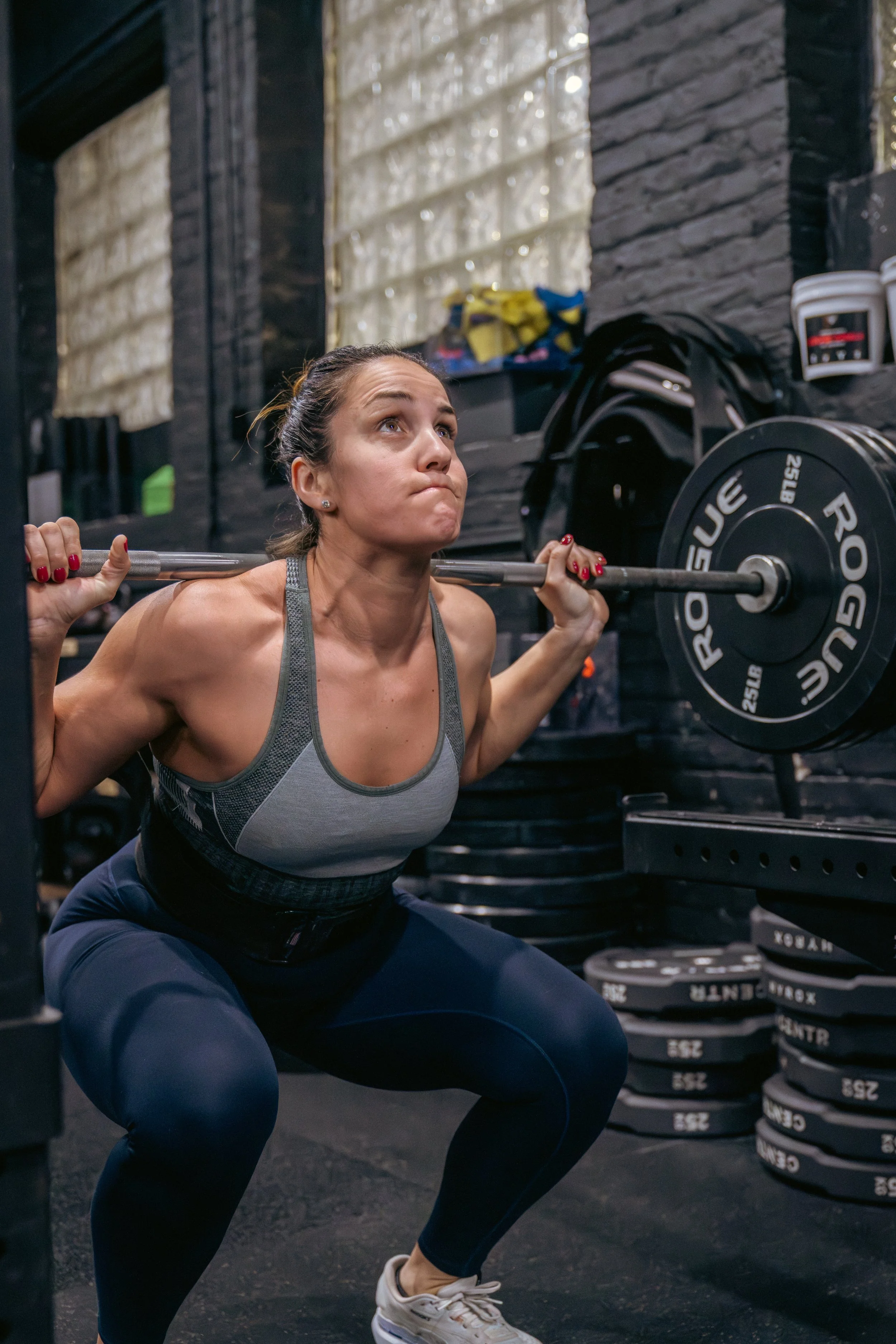
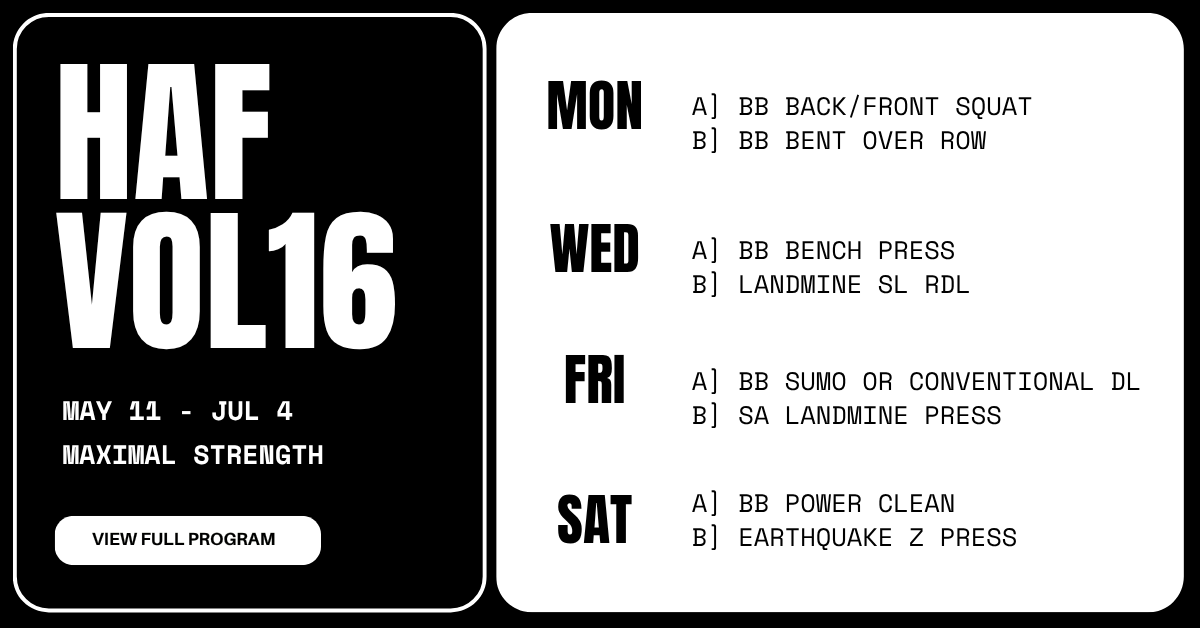
MONDAY
A] BB FRONT/BACK SQUATS
B] BB BENT OVER ROW
Our main lift on Mondays will be the athlete's choice between Front Squats and Back Squats using 3-2-1-0/1 tempo on all build-up sets. We recommend switching your squat variation every 2 training cycles or so.
Front Squats are beneficial for athletes looking to improve squat positioning, bar path control, upright posture, quad strength, and carryover to Olympic lifts. They also tend to transfer well for athletes competing in 13.1 or APEX, specifically for the 40-yard dash, vertical force production, bracing under fatigue, trap bar positioning, and athletic posture during jumps and throws. Because front squats create less overall spinal loading and systemic fatigue, they also pair better with increasing run volume and speed work.
Back Squats are also incredibly valuable. They allow athletes to move heavier loads and typically place greater emphasis on the posterior chain, specifically the glutes, hamstrings, and total-body force production. If your goal this cycle is building absolute strength and chasing heavier numbers, this may be the better option for you. The tradeoff is that back squats can lead to greater overall fatigue and stiffness, which may affect recovery for higher-volume conditioning and increased running mileage.
Whichever variation you choose, the goal remains the same: move well, own strong positions, and progressively build strength over time. For B Block, we’re keeping the posterior chain energy alive with Bent Over Barbell Rows to reinforce the upper back and lat strength required to support strong squat positioning and bar control.
And… BULGARIANS are back.
Last cycle focused heavily on developing single-leg stability and control through pistols and single-leg box squat variations. This cycle, we’ll build on that foundation by loading unilateral patterns heavier and challenging strength, balance, and positional control under fatigue.
Monday finishes with frontal core and shoulder accessory work, leaving us feeling very accomplished at the start of the week. Because everyone in CHicago knows... Mondays Start Here (Shot Out to Garage Run Club)!
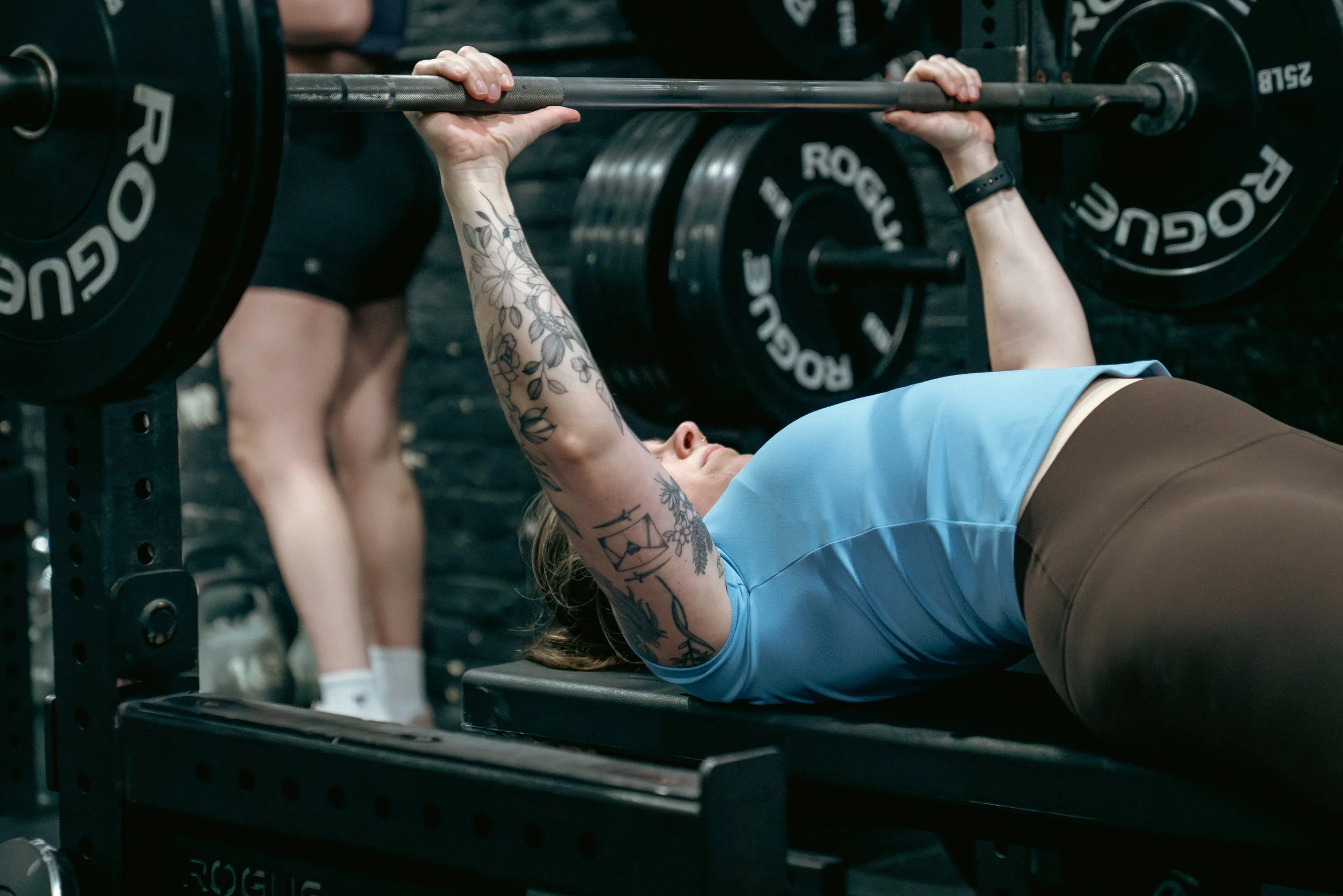
WEDNESDAY
A] BB BENCH PRESS
B1] LANDMINE SL RDLS
We’re back to the bench using 3-2-1-0/1 tempo on all build-up sets for the Bench Press. It is one of the few strength-training exercises that require excessive spinal extension. Arch your back and pack your shoulders. This puts you in the best possible and safest position to press. Additionally, spinal extension generates the most tension in your posterior chain to stabilize your lift. It is best performed with a partner because safety comes first.
Those Larsen Presses in Vol 15 were humbling… but did us well in correcting our pressing positions. Landmines are also back and loaded up for some juicy single-leg hinge work. We are also adding in some Bottoms Up Kettlebell Carries to expose shoulder instability in real time. Stronger rotator cuff = tighter bar path = healthier shoulders under load. Transverse core and lower body isometric holds will round out a spicy mid-week lift.

FRIDAY
A] BB SUMO/CONVENTIONAL DL
B1] SA LANDMINE PRESS
When it comes to sumo or conventional deadlifting, athletes are typically team sumo or team conventional, never really both. We are big believers in being well-rounded athletes. Everyone should be able to perform both types of deadlifts. So, just like squats, we will encourage you to switch your deadlift variation every 2 training cycles or so.
However, similar to your squat stance (feet out or feet forward), your anatomy will dictate where you feel more comfortable. Or which is more optimal for heavy lifting.
Athletes generally fall into two categories: Long arms and short torsos or short arms and long torsos. If you have long arms and a short torso, you should pull conventional. If you have a long torso and short arms, sumo suits your anatomy better. Additionally, strength and flexibility also affect which deadlifting style will be more comfortable. The conventional deadlift is better for those with strong glutes, hamstrings, and lower back muscles. Pulling sumo uses the quads and adductors to a greater extent than conventional, but also requires above-average adductor flexibility. Talk to your coach. We’ll help you figure it out.
Athletes may choose conventional or sumo stance. Build up sets on the deadlift this cycle for the first 4 weeks will feature that 3-2-1 tempo: a strong concentric drive, 3-second controlled eccentric (lowering), and a true dead stop reset at the bottom. Yes, you'll need to check your ego on the load. The slower descent forces true hinge mechanics, consistent lat engagement, and cleaner positioning throughout the lift. Weeks 5-8 will lose the tempo, building to a stronger but controlled lift as we work toward our next test out week and some serious gains.
Upper Body work on Fridays will see Single Arm Landmine Incline Presses with our pull up progression: Seated Pull Ups, advancing toward a true L-sit pull up. The seated and L-sit variation demands strict midline stability and core bracing similar to what you'd find in a heavy squat or deadlift. The lats, abdominals, obliques, and hip flexors all work to maintain position throughout the entire range of motion, translating to better engagement on the barbell and serving as an effective step toward stronger pull ups and chin ups. Sagittal core and a bicep pump will close out your work for the day. Wrapping up feel-good Fridays.
For athletes competing in APEX, we recommend utilizing the Trap Bar we have available throughout this training block, as the competition will test a Trap Bar Deadlift AMRAP event. Building familiarity with the setup, positioning, bracing, and repeated effort under fatigue will all help carry over to competition day.

SATURDAY
A] BB POWER CLEANS
B] EARTHQUAKE Z PRESS
Saturdays are staying true to form with our Olympic weightlifting. Focus will be on cleaning up our cleans -mwaha- and our first 4 weeks of tempo will be seen on the concentric drive, meaning a slow, deliberate pull. This will humble your load but the payoff is significant: it forces you to own every position through the lift rather than relying on momentum to carry you through. Working sets will return to regular explosive tempo. Let it rip with, intention!
The Earthquake Z Press introduces oscillating load through hanging kettlebells or plates on the bar with bands, demanding constant shoulder and midline stabilization. You can’t fake stability here!
Saturdays include a full shoulder assault, courtesy of Coach Eric. The Boulder Shoulder Trio hits the deltoids from every angle: anterior, lateral, and posterior. Expect front raises, seated eccentric lateral raises, and seal rear flys with a pause at peak contraction. Lightweight, high intent. The muscles you can't see in the mirror matter just as much as the ones you can.
Strength doesn’t happen overnight.
The athletes who make the biggest progress this cycle will be the ones who show up consistently, respect the progression, and treat every rep like practice for the next PR.
We’re so proud to coach you.
We’re so excited to see what you accomplish over the next eight weeks.
WHAT’S HAPPENING AT THE GARAGE?
NOW UNTIL MEMORIAL DAY
Before we sign off, there’s something we do differently here at The Garage. We build more than stronger athletes. As our community continues to grow, we never want to lose sight of what matters most: showing up for others. Now through Memorial Day, we’ll be raising money for Merging Vets & Players, an organization helping combat veterans and former professional athletes rediscover community, identity, and purpose after the uniform comes off. Their mission is rooted in something we believe deeply here at The Garage: no one should have to navigate hard transitions alone.
Movement has always been bigger than workouts. It’s about connection. Belonging. Having a community by your side when life gets heavy.
Our goal is to raise $1,000 before Memorial Day.
THU MAY 14
Lincoln Park Schedule opens for Community week, which runs from Monday, May 25th, to May 31st. You can officially start signing up for LP classes that week on Thursday, May 14th!
SAT MAY 16
Click here « to show up for our crew competing in the windy city's strongest this weekend. Located at the Chicago Barbell Compound from 10am - 2pm
SUN MAY 17
Click here « if you're competing in hyroxer / 13.1, this is a photoshoot moment for our athletes. Reserve your spot. Details to follow.
THU MAY 21
ALIGN is back. Garage members can now access The Apartment every Thursday night at 6:30 PM. Expect mobility, joint strength, and body control designed to help you move better long term.
MON MAY 25-31ST « Community Week @ LP
MON JUN 1 « LP Opens
New Garage Run Club Route Begins
Now let’s get to work, team garage!