HEAVY AF VOL 14
Hello, all my Strong Friends!
In this email, expect a full breakdown of our HAF program, some insight into movement choices across our week, and some topics at the end, I think you’ll find helpful and/or interesting.
The email will run as follows:
The Plan - General outcomes for this program
Monday - Zerchers & Step Ups
Wednesday - Overhead & Sleds
Friday - Yates Deadlift & Bench
Saturday - C&PJ & Overhead Squats
Extra Stuff - Your technique sucks in conditioning workouts
Injury Protocols
THE PLAN
Firstly, I’d like to acknowledge my new HAF’ers in the gym! Welcome!
For my newbies, my intention with our HAF program is fairly simple: create the most powerful, strong, and yoked athletes possible.
To achieve this, in HEAVY AF we train multiple qualities of fitness simultaneously. The qualities of fitness we train in HAF, generally, are mobility, strength, hypertrophy, and power.
We train multiple fitness qualities at the same time because mobility, strength, hypertrophy, and power share overlapping physiological mechanisms and can be stimulated through different loading, velocity, and volume strategies within the same training program. Top tier explanation here from Coach Ash, sheesh.
For example, strength and hypertrophy both rely on increased muscle fiber recruitment and adaptation, while power builds on strength by emphasizing the rate at which force is produced.
Additionally, mobility is the ability of a joint and the surrounding tissues to move actively through a full, controlled range of motion with adequate strength, coordination, and stability. Generally the more mobile you are the more opportunities you will have to elicit power, strength and hypertrophy demands safely and efficiently.
By varying intention, intensity, rep ranges, movement speed, and exercise selection (e.g., heavy lifts for strength, moderate loads for hypertrophy, explosive movements for power and movements that expose joints to full ROM for mobility), the body can adapt to multiple stimuli concurrently.
I know what you’re thinking, “wow Ash, you’re so smart”. Correct.
Ok, let's get into the program.
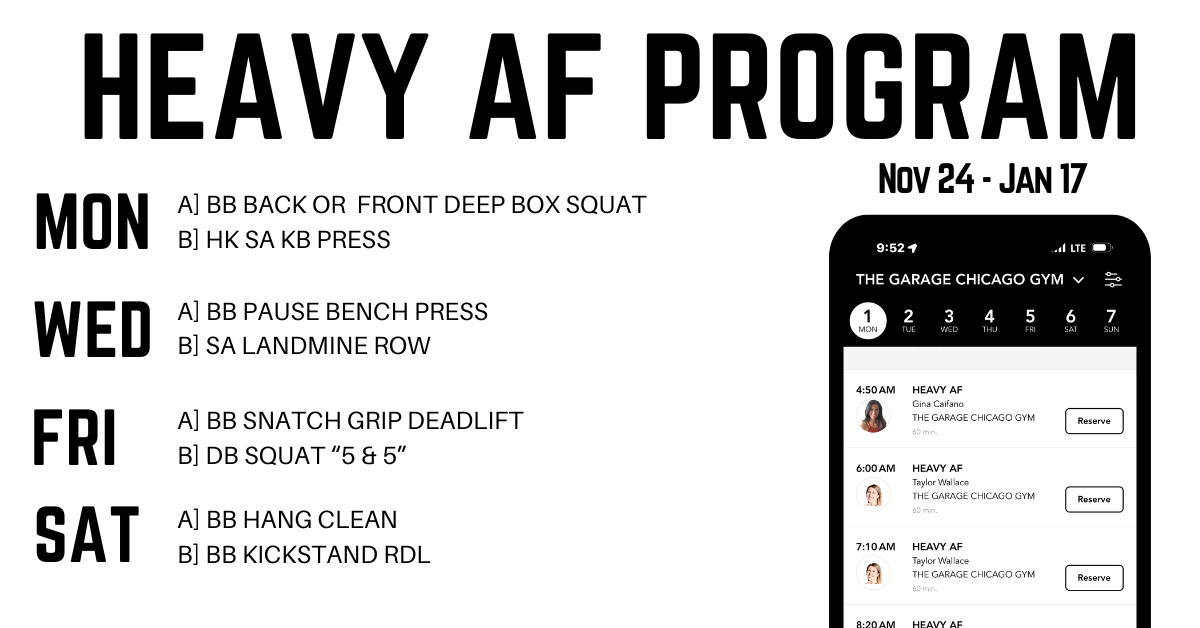
MONDAY
SQUAT VARIATION OF YOUR CHOICE
The primary movement on Monday will be a Squat variation of your choice. Your options through this cycle are Front, Back, or Zercher Squats. Pick one, and stick with it!
I’d recommend no more than two HAF programs on the same squat variation.
The one that everyone seems to care about the most is the back squat. However, different squat variations can bias different outcomes and may allow you to work on your weaknesses more efficiently.
For example, the front-loaded position in a front squat pushes your centre of mass forward, allows you to find more depth, promotes a more upright position, and challenges balance. Exposure to this variation will help you when it comes to your overall efficiency in a back squat.
If you’re someone who needs a little more depth or thinks your overall squat form could do with some help, front squats will be for you.
Alternatively, back squats have the highest load potential of the options. So if you’re someone who feels your squat form is in a good place, and you want to as efficiently as possible build some cake, back squats will be your jam.
Finally, Zerchers are really cool. This is a new option this cycle to give you guys something fun and different. The zercher is a squat variation where the barbell is held in the crook of the elbows (it kinda hurts, but you’ll get used to it). The zercher is similar to a front squat in that it promotes a more upright squat posture; it also strongly challenges the core and upper back. So if you want big ol’ traps and to try something new - go for the Zerchers.
KB STEP UP
On the other side of the room will be a Kettlebell Step Up. This will be performed to a tall box, exposing you guys to a deep range of motion, and will utilize a front rack position to help avoid swinging or momentum to get up there.
This will be grouped with some push-up variations, some side bends, and an upper body pump.
WEDNESDAY
SEATED BARBELL OVERHEAD PRESS
The primary movement on Wednesdays will be a seated barbell overhead press. The seated barbell press should be performed with the elbows stacked under the wrists, lifting through the greatest ROM available - I like the coaching cue, get the bar behind your ears.
Rather than using the J-hooks, this exercise should be performed with the safety arms up as the main supporting structure for the barbell.
An important point to make here is that strength training is very similar to mobility training. The only difference is intention/focus.
When strength training, we perform exercises to a particular movement standard with the focus being on weight. In mobility training, we can perform the same exercises but with the focus being exposure to end-range positions.
This is particularly relevant when it comes to overhead pressing because generally, most people have poor overhead mobility.
If you want to improve overhead mobility, the ONLY thing you really need to do is switch your intention/focus.
Focus more on getting consistent exposure to the very end range available to you and less on the amount of weight you’re lifting. Over time, this will become more fluid and comfortable, and then you should start adding weight.
There’s no special stretch or "activation" you need. You just need to intentionally move through your available range of motion, touching the end of motion consistently, and over time, it will strengthen and improve.
Your coach can advise you as to which intention you should focus on, but generally I think ya’ll know if you aren’t getting the range of motion you should be!
SLED PUSH
Your secondary movement on Wednesdays will be a HEAVY sled push. We haven't done this in a while, and it’ll be fun to load this movement on the new turf with our new sleds..
The main benefit, in my opinion, for sled work isn’t necessarily strength but increased work capacity. The term "work capacity" refers to your body's ability to tolerate, recover from, and adapt to a given amount of stress.
It is generally accepted that the more stress we can impose on our systems - while optimally recovering from that stress - the more gains we will ultimately be able to make in the long run.
So what I'm saying is that pushing a heavy sled will help your ability to work hard in all our other heavy lifts.
Your sled pushes will be grouped with a rowing action, some twisting core work, and some high-volume lower-body accessory stuff.
FRIDAY
YATS DEADLIFT
If you were writing a program and knew someone who could deadlift well into 500 lbs for reps, you’d probably ask for their input, right? Right.. So anyway, I texted Coach Eric, and he suggested that for the first four weeks of this training cycle, we implement a movement called the Yates Deadlift before switching to a conventional deadlift.
The Yates deadlift is an Eccentric-driven variation of the deadlift that trains the stretch-shortening cycle of the muscles involved, unlike the conventional deadlift. It’s basically an RDL where you bend your knees.
The bar will start from the top, rather than the ground, and involves lowering the bar an inch or so from the ground by means of hinging and bending the knees.
This variation of deadlift builds leg drive with a focus on upright posture and increased knee flexion compared to an RDL. It has a high isometric demand through the upper back and creates stability demands, maintaining balance throughout the foot. All contributing to a more efficient deadlift when we switch back weeks 5-8.
DB INCLINE PRESS
The secondary movement on Fridays will be a DB Incline Press, to give the chest a little love. This exercise will be grouped with a pulling variation and some direct ab work.
SATURDAY
BB HANG CLEAN PUSH JERK
Your Saturday HAF is usually orientated toward Olympic weightlifting. For my newbies, Olympic weightlifting is a strength and power sport centered on two competition lifts: the snatch and the clean and jerk.
It requires a combination of explosive power, speed, mobility, technique, and coordination to lift maximal weight from the floor to overhead, making the general qualities of the sport align very well with HAF.
I would describe OLY weightlifting as a great way to display strength and power, but not the most efficient way to build it. Nevertheless, it’s an amazing sport, and learning the skills required to perform movements like a Clean and Jerk or snatch will add more tools to your toolbox and provide more ways to measure training and improvement.
The primary movement on Saturdays will be a Hang Clean into a Barbell Push Jerk. We worked on Hang Cleans in the previous program, and now we are adding another movement on top, the push jerk.
The barbell push jerk is an explosive overhead movement where you dip slightly at the knees and hips, then powerfully drive the bar upward using the legs before quickly dropping under it to catch the bar with locked arms overhead.
It emphasizes power development, coordination, and full-body strength, and is commonly used in Olympic weightlifting, leading to the conventional Split Jerk.
OH SQUATS
On the other side of the room, for the first time, we will be working on overhead squats. Overhead squats offer numerous benefits, but mainly in this context, the demands of mobility in the shoulders, hips, ankles, and thoracic spine, leading to better movement is what we’re looking for.
As previously mentioned, exposure to different end range positions is how we improve mobility, and working to a stable overhead squat has comprehensive benefits that carry over to many other exercises that we perform, including squats and overhead presses.
Your overhead squat work will be grouped with a cardio effort on the bike, lunges, and an upper body pump.
EXTRA STUFF
Ok, here’s a couple of questions/topics that I think ya’ll could benefit from exploring…
YOUR TECHNIQUE SUCKS IN CONDITIONING WORKOUTS
Woah big statement! Ok this applies to some people in our STRONG X and HYBRID classes, those people will be listed at the bottom of this email…
This is something that is very normal in the group fitness space and happens for a few reasons.
Firstly, most of the conditioning workouts we do at TGC have some degree of competition - if that's racing the clock or each other. What this means is that there's a huge sense of urgency in the workouts. In that urgency, we often lose rep quality in exchange for rep speed. Dumbbell Snatches or Goblet Squats are a great example of this - not getting the dumbbell all the way up or not sitting all the way down.
An alternative reason may be athletes selecting an inappropriate weight that doesn’t align with their technical competency or strength level. Heavier weight isn’t better if you can't demonstrate correct technique.
The issue is: Performing half reps in workouts, if that's due to trying to go fast or going too heavy, undermines your physiological progress.
Consistently skipping depth or ROM reinforces poor movement patterns and can lead to mobility restrictions and uneven joint loading over time.
In addition to this, not performing full ROM can lead to what I’d call distorted conditioning adaptations: basically, shortened reps reduce actual work performed, leading to less cardiovascular and metabolic stress than intended, which blunts conditioning improvements. THEN because the nervous system and muscles aren’t challenged appropriately, long-term adaptation slows despite higher rep counts or faster times.
In short, full, honest reps maximize training stimulus, durability, and long-term performance gains. So stop cheating, ya weenies.
INJURY PROTOCOL
What to do with aches and pains when it comes to lifting is a discussion I often have with ya’ll. So for the group, this is the general advice I give:
If you’re dealing with aches or pains (soft tissue injuries), I wouldn’t stop moving altogether. The goal isn’t to avoid discomfort completely; it’s to manage the intensity of your lifting. If you’re hurt, lower the intensity of your lifting until you feel better.
Movement is medicine. Blood flow helps tissues heal, and staying in the gym helps you maintain confidence and momentum. Don’t stop training—but definitely adjust how you train.
That means scaling: you can shorten the range of motion, slow the tempo, and/or probably most importantly lighten the weight so you can keep moving without flaring things up. Look for “tolerable discomfort” where the muscle is still working and getting stronger, not worse.
A helpful way to think about injury management is the acronym MEAT:
Movement to keep joints and tissues healthy, Exercise to progressively rebuild strength, Analgesics if needed to manage pain, and Treatment like mobility work, manual therapy, or coaching support. MEAT reinforces that active recovery beats complete rest almost every time.
In summary: stop resting and start recovering. Scale with intent, keep moving, and let smart training do the healing.
OK, team that’s all I got, love ya’ll
Let’s get it!