Double-click to edit...
Hey Garage fam,
One of our favorite things about Test Out Week is watching a weight that used to be your top set become your warm-up. Thank you for trusting the process, showing up week after week, and getting stronger with us.
Now we get to build on it. HAF Vol 19 | Strength Meets Performance is our next 12 weeks of training. We’ll build muscle, get stronger through more reps, and finish with a heavy set of five in Week 12.
Chicago winter is around the corner, and so is HYROX Chicago. For a lot of you, the next few months are going to look like dark mornings, extra layers for the outdoor run, and a whole lot of time training together before we get to Navy Pier.
And yes, Friday Deadlift Day is back. We’re bringing it back in three phases. We’ll show you why we’re building Fridays that way, what you’ll lift each day, and how the strength work fits alongside your Hyrox prep.
WEEKLY BREAKDOWN
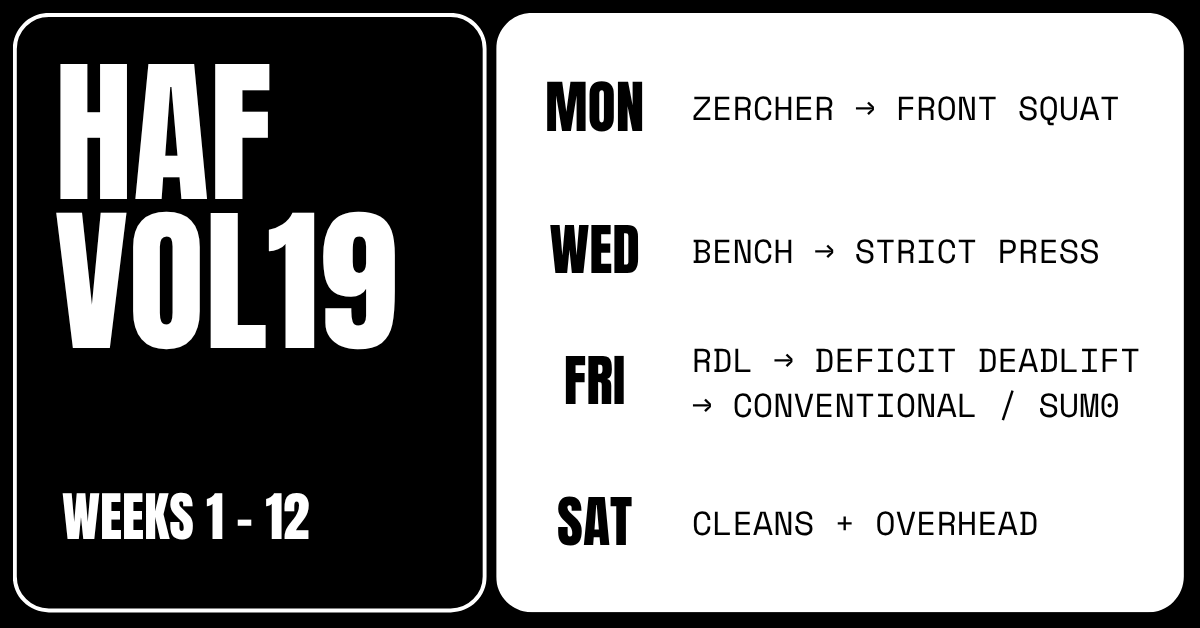
Starting this volume, our upper-body pressing movement is back on Wednesdays, and our hinge returns to Fridays. Cue the nostalgia for Friday Deadlift Day! We changed up our split the last 12 weeks, but now we are SO BACK! With marathon season behind, this setup gives your legs more rest between Monday squats and Friday pulls. Let’s get into your HAF program breakdown
MON | Squat, lunge, row
ZERCHER SQUATS → FRONT SQUATS. For Weeks 1–6, we will perform Zercher squats where the bar sits in the crease of your elbows, which encourages an upright torso and a strong brace. This front-loaded position demands core strength, bracing, and quad and glute strength. For our HYROX athletes, this front-loaded hold carries over to maintaining posture and stability for sandbag lunges. After six weeks, we’ll transition to Front Squats. With mechanics established, the front rack lets you load heavier while staying upright. We’ll continue building lower-body strength and core stability as we work toward our 5RM test.
WALKING LUNGES: We’ll change the loading position every four weeks. For walking lunges, we will build unilateral strength, balance, coordination, and muscular endurance. As the loading positions change, we’ll continue challenging your stability and control while progressing toward heavier, more race-specific lunge work.
Neutral Grip Landmine Row → Pendlay Row → BB Bent Over Row. We’ll start with the Landmine Row for the first four weeks. The fixed bar path and neutral grip guides the bar path, allowing us to establish controlled pulling mechanics and build foundational upper back strength. In the middle of this training block we’ll perform a Pendlay Row. Each rep starts from a dead stop on the floor, with an explosive pull towards the torso. This challenges force production and the ability to generate a strong pull from a stationary position. We’ll then move to a Bent-Over Barbell Row, which uses continuous reps, allowing heavier loads and more time under tension to build upper back endurance. This progression is all about controlled pulling, scapular control, and pure upper back strength. Strong, sexy backs!
We’ll finish with straight-leg sit-ups progressing to hollow holds, reverse Nordics, and yes, a biceps pump.
WED | PRESS, HIP THRUST, CARRY
BENCH PRESS → BB STRICT PRESS. We’ll keep the bench for Weeks 1–6 and give you more reps per set. We just tested our 1RM Bench Press, so we’re going to keep it rolling for the next six weeks, shifting the focus to higher rep ranges to build muscle and pressing endurance. (And the stronger your press, the better you’ll be able to push off the floor with those burpee broad jumps!). In the second half of this training cycle, we’ll switch to a BB Strict Press. This one is always humbling! No leg drive allowed. Your shoulders and core do the work as you press the bar overhead with control.
Single Leg Hip Thrust → Barbell Hip Thrust. We loved this one so much during marathon prep, we had to bring it back! The first six weeks we’ll perform a dumbbell-loaded single leg variation. Unilateral work exposes and addresses strength imbalances while developing glute strength, pelvic stability, and single-leg control. All great things for your running stride! In week 7, we’ll transition to bilateral Barbell Hip Thrusts. Using both legs allows you to load heavier, and paused reps will add extra time under tension. Reps will stay high, so this one is going to get spicyyy! The hip extension strength developed here supports running stride power and lower body force production, translating well for things like sled pushes and pulls.
COSSACK → LATERAL SQUATS. Let’s work on your mobility! The first half of this cycle we’ll perform Cossack Squats, working through a deep range of hip, knee and ankle flexion to develop better hip mobility, adductor strength, and control in the frontal plane. We’ll then switch to Lateral Squats loading this pattern up, turning the better mobility and control we’ve developed into loaded lateral strength.
PARALLEL BAR DIPS → LYING DB TRICEP EXTENSION. Parallel bar dips build upper-body pressing strength, primarily targeting the triceps, chest, and anterior deltoids. Paired with bench press, they provide additional pressing volume while developing triceps strength, shoulder stability, and control through a different range of motion. After six weeks, we’ll shift to Lying DB Tricep Extensions to isolate the triceps and continue building strength and endurance to complement our pressing movements.
SUITCASE CARRY → 2KB FARMER CARRY. Single-side carries build unilateral core strength and the ability to resist lateral flexion, improving stability and control during everyday movements and athletic activities. Heavy Farmer Carries build grip strength, core stability, and a more resilient back that challenge posture, bracing, and total-body control under load.
FRI | DEADLIFTS, PRESS, PULL
ROMANIAN DEADLIFT→ DEFICIT DEADLIFTS →CONVENTIONAL/SUMO DEADLIFT. The first four weeks we’ll perform Barbell Romanian Deadlifts. The intent is to build posterior chain strength, hamstring and glute development, and strong hip-hinge mechanics. The RDL starts from a standing position in full hip extension and emphasizes a slow, controlled lowering phase into the hinge. Reps will stay high, so use those straps to help with your grip as you perform your sets. Week 5 we’ll begin four weeks of Deficit Deadlifts. Standing on our 1-inch DC blocks, we’ll increase range of motion and challenge our ability to generate force from the floor. This builds starting-position strength and fully-body tension that carries over to regular deadlifts and heavy sled pulls. The final four weeks we’ll put it all together with regular deadlifts– conventional or sumo. This is where we express the strength we’ve developed with optimal leverage. The deeper starting position from Phase 2 will make pulling from standard floor height feel noticeably lighter.
SINGLE ARM STANDING SHOULDER PRESS → DB CHEST PRESS. We’ll start by building unilateral shoulder strength, stability, and core control through standing single-arm presses. This complements our Wednesday Bench Press while preparing us for the transition to overhead pressing in the second half of the cycle. Once Wednesday shifts to the BB Strict Press, we’ll move to DB Chest Press on Fridays to maintain our horizontal pressing strength and keep a balance of upper-body pushing movements throughout the week.
INVERTED ROW → PULL/CHIN UP NEGATIVES → STRICT PULL UPS. Weeks 1-4: We’ll reinforce proper scapular engagement and foundational pulling strength with higher volume inverted rows. Athletes will be encouraged to elevate their feet on boxes to find a parallel body position. Week 5: We’ll move to a vertical pulling position with controlled negatives. Time under tension will increase for four weeks to build better strength and control through the lowering phase. We’ll then finish out our final four weeks with strict Pull or Chin ups, putting that newly developed pulling strength to the test.
We’ll finish with kettlebell side bends progressing to star planks, plus push-ups and calf work.
SAT | CLEANS, OVERHEAD WORK, GYMNASTICS
Saturdays will bring the power side of Strength Meets Performance as we continue to have a weightlifting focus with a Clean to Overhead Progression. This volume, we’ll work through 3 progressive phases, with deloads in weeks 4, 8 and 12.
WEEKS 1-4: We’ll build technique and perform paused and tempo Clean variations while building our Push Press strength through heavy triples.
WEEKS 5-8: We’ll progress to above-the-knee tempo and paused Cleans, developing stronger positions and more control throughout the lift. Our overhead work will move through Push Presses, Power Jerks and Jerks, building toward heavy singles. Week 8 brings us to a deload Power Clean and 5 rep Strict Overhead Press.
WEEKS 9-12: We’ll shift to Hang Power Cleans and Clean Pulls, building toward a heavy single Hang Power Clean in Week 11, paired with a heavy single Push Press to Jerk. Week 12 will bring another deload of Clean Pull + Clean and Push Press + Jerk singles.
You’ll also see paused back squat singles, overhead carries, and higher-rep single-leg work. For gymnastics, we’ll keep working on toes-to-bar, kipping pull-ups, and muscle-up progressions. If you’ve been curious about any of those, come in. We’ll start with the progression you’re ready for.
Book your first week of HAF in our TGC app. Bring your Test Out numbers if you have them. If this is your first volume, we’ll help you find a starting weight. Either way, write down what you lift in Week 1 so you have something to build from.
Train hard enough to change. Recover enough to keep changing. Now let’s go lift heavy as fuck.
LOVE,
THE GARAGE CHICAGOL