haf vol 18: It’s time to express your strength.
What’s up Garage athletes,
Shoutout to our athletes who competed in Coalition Throwdown this weekend: Christine Scott & Emily Flores, McZiggy Richards & Josh De Lara, and Victoria Bacigalupo & Alexis Servos.
You can measure strength by the weight on the bar. Or you can watch our Garage athletes show up for each other. We saw a lot of that this weekend. They communicated, adapted, and found another gear for each other. Strong athletes. Humble people. Damn good teammates.We’re also celebrating Artem & Rach on their engagement, and all of our Garage athletes celebrating big life moments lately. Strong lifts are great. Finding the right person to do life with is pretty high on the list, too.
Now we turn the page.
Chicago is heading into one of the biggest training seasons of the year. Face Off x Athalon Games, Hyrox Season, and, of course, the Chicago Marathon. Maybe you’re training for all of it. Maybe none of it. Maybe you just want to get stronger, move better, and stay capable for a very long time.
HEAVY AF VOLUME 18 is built for all of that.
Over the last three volumes, we’ve been quietly stacking the pieces:
V15: Find strong positions through pin squats, larsen presses, and paused reps.
V16: Own those positions through tempo, control, and time under tension.
V17: Build strength inside those positions.
V18: Express it.
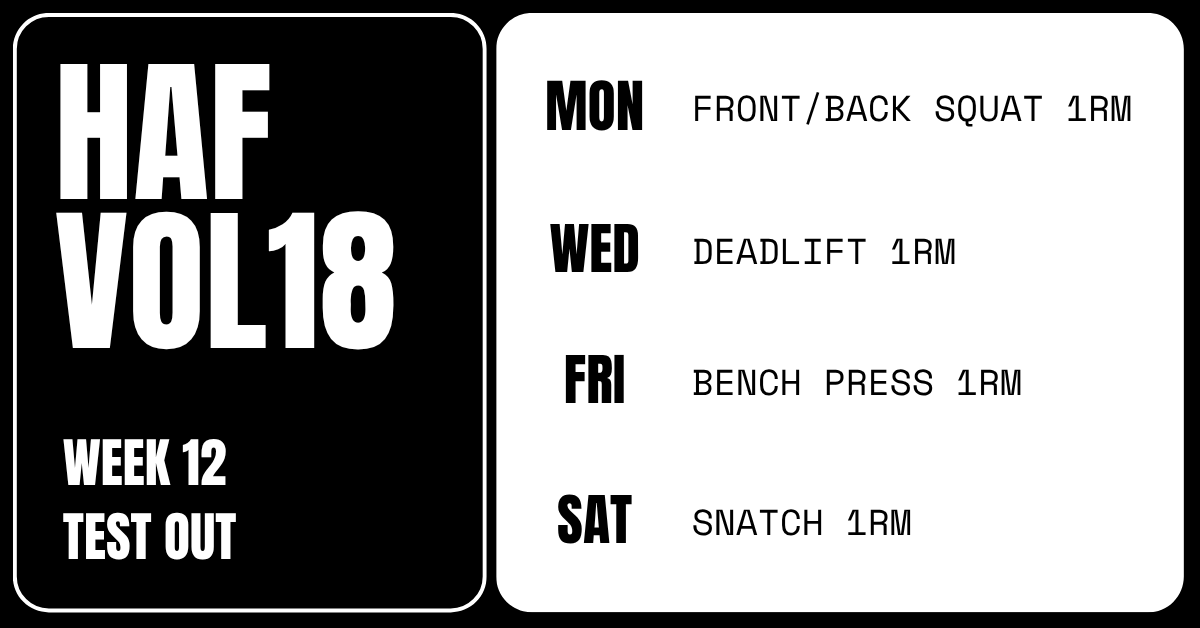
HAF V18 is a 12-week progression ending with a 1-REP MAX TEST OUT in Week 12. But there’s an important difference between building strength and testing strength. Before we ask you to show us what you’ve got, we’re going to keep earning it.
YOUR HAF ROADMAP
WHY THE WEEK IS CHANGING
The biggest structural change in this volume: our posterior-chain work moves from Friday to Wednesday. Good programming is not about seeing how much work an athlete can survive. It is about applying the right stress in the right place, then giving the body enough room to adapt. By Friday, most athletes are carrying more than training stress. You have accumulated training sessions, work, imperfect sleep, life, and whatever else the week decided to hand you. And then there are our runners. Friday Deadlifts and Saturday long runs were never a love story.
Moving our heavier posterior-chain work to Wednesday allows us to train it with more quality while creating additional recovery before weekend mileage. It gives our runners a better setup without taking strength training away and creates a cleaner distribution of stress for everyone.
MONDAYS: LOWER BODY STRENGTH
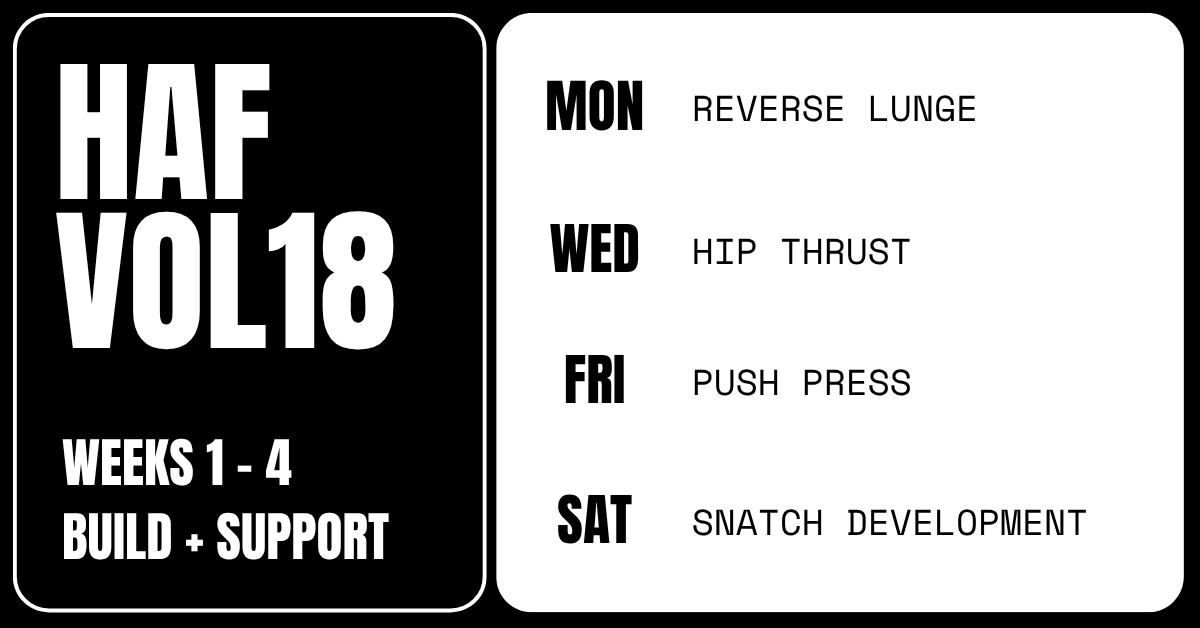
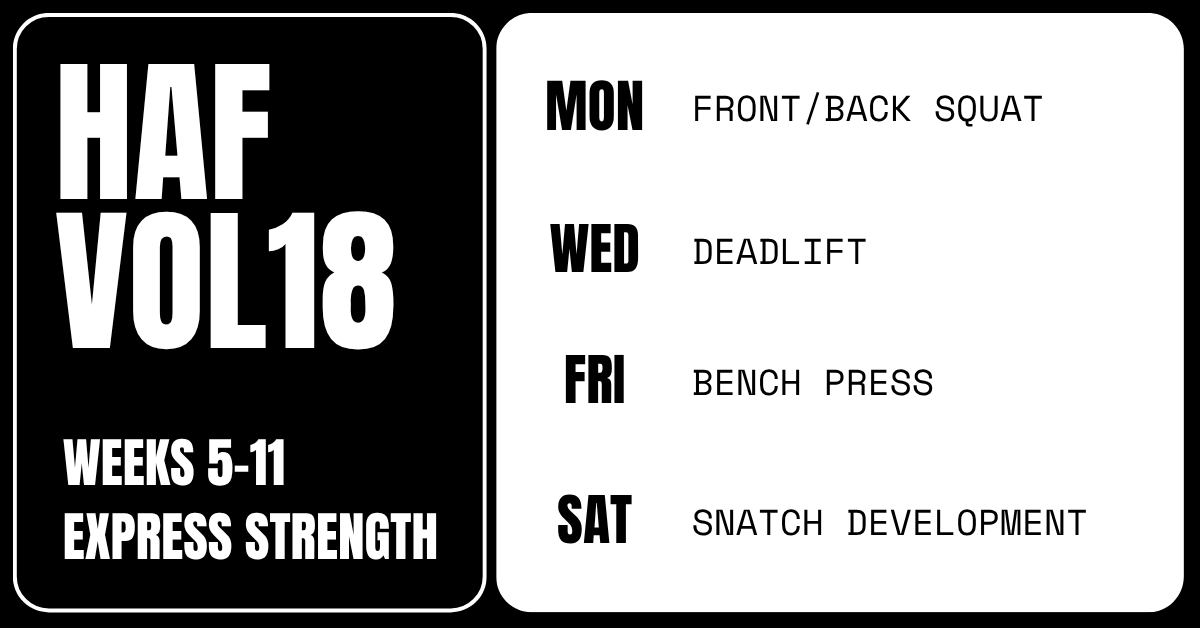
We begin with four weeks of Barbell Reverse Lunges. Before returning to heavier bilateral squatting, we’re building strength one leg at a time. Unilateral training develops hip stability, exposes side-to-side differences, and lets us load the lower body without immediately adding another block of heavy bilateral squat volume. Beginning in Week 5, the Squat returns as the primary strength lift. Your heavier top sets expose you to increasing load. Your back-off work gives us the quality volume underneath it. Strength is not built from one heroic set. For our marathoners, you’ll notice intentional reductions in lower-body volume around peak mileage and taper weeks. The goal is to preserve strength without adding fatigue that competes with the work that matters most for your race.
WEDNESDAY: POSTERIOR-CHAIN STRENGTH
Weeks 1–4 emphasize the Barbell Hip Thrust while keeping strategic exposure to the Conventional Deadlift for those competing in Face Off race day demands. Beginning in Week 5, the Deadlift becomes one of our primary strength lifts. The goal is to progressively increase force production and posterior-chain capacity while leaving enough recovery to actually benefit from the work. More soreness is not the goal. More strength is.
FRIDAY: UPPER-BODY POWER → BENCH STRENGTH
Moving Deadlifts off Friday gives this day a completely different job. Weeks 1–4 center around the Barbell Push Press. We’re asking you to produce force quickly, transfer it through the trunk, and finish overhead with speed and control. Beginning in Week 5, Bench Press becomes our primary upper-body strength lift and starts its progression toward Week 12.
That gives us heavy lower-body work earlier in the week and upper-body work later, instead of repeatedly asking your legs to absorb high stress going into the weekend. We like to say a cleaner weekly distribution of stress.
SATURDAY: OLYMPIC LIFTING + POWER
Saturday is where strength learns to move fast. The Snatch asks for something our slower strength lifts do not: rapid force production, timing, coordination, and the ability to receive a moving barbell in a strong position. That’s why we don’t start by simply loading the bar and hoping for the best. We use muscle snatches, overhead squats, snatch balances, pulls, and hang variations to build the pieces. Then we progressively put those pieces together. Strength gives you force. Power determines how quickly you can use it.
Across all four days, the principle is the same: Do enough work to create an adaptation. Not so much that you interfere with the next one.
As the cycle progresses, training volume will gradually decrease while the weight on the bar increases:
VOLUME → STRENGTH → INTENSITY → CONFIDENCE → TEST
You have spent months learning how to brace, control your body, find strong positions, and stay composed under load. Now we’re teaching you how to trust what you’ve built. As the weight gets heavier, remember: DON’T RUSH THE WEIGHT. EARN IT.
A heavier bar does not replace good movement. Your positions still matter. Your setup still matters. The reps you choose not to force matter, too. We are not trying to survive 12 weeks and hope adrenaline saves us on test day. We are trying to build so deliberately that when Week 12 arrives, you already know you’re ready.
WHAT IF YOU MISS A LIFT?
Life happens. Travel happens. Work schedules happen. If you miss one of the week’s primary HAF lifts, you can make it up at the beginning of a Z2 class before joining the aerobic work. Remember: if making up a lift hurts the quality of your next session, it is no longer helping the program. The goal is quality training, appropriate recovery, and steady progress over time
IF YOU'RE NEW TO STRENGTH TRAINING, WELCOME.
You are not behind. You are beginning, and that matters. Progressive resistance training is one of the most important investments you can make in your long-term health. We are playing a much longer game.
We are building bodies that can handle competitions, starting lines, careers, parenthood, aging, and whatever else life decides to write into your story.
Now let’s see what your strength can do.
The Garage Chicago Team